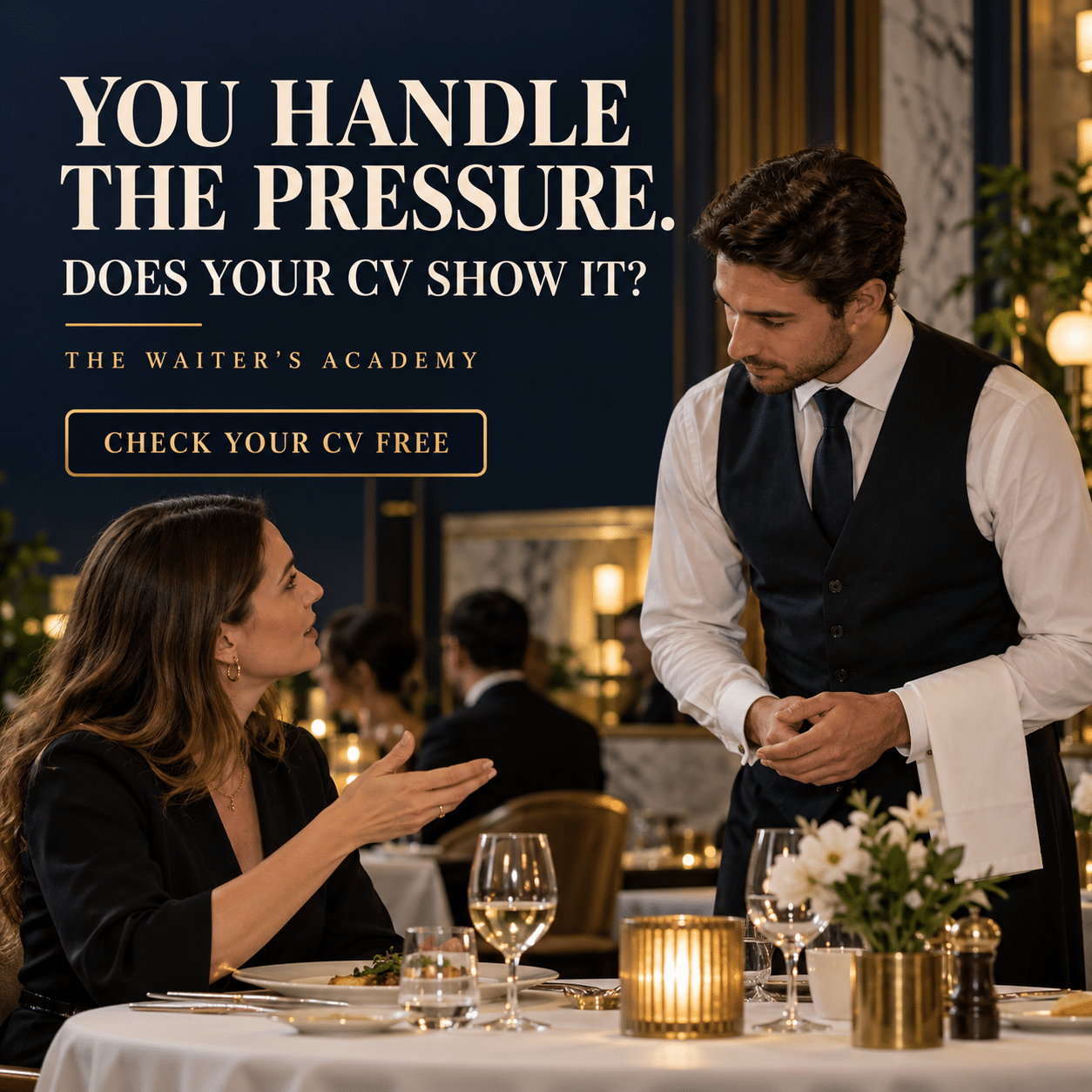
You calmed an upset guest, coordinated with the kitchen and kept service moving.
Then you wrote “excellent customer service” on your CV.
That phrase leaves out the most useful part: what you actually did when service became difficult.
If you have handled complaints in a restaurant or hotel, you have specific experience to describe. Here is how to turn it into clear CV evidence without exaggerating your authority or inventing results.
1. Choose one incident you can explain
Start with a real situation: a delayed meal, an incorrect order, a disputed bill or a reservation misunderstanding.
Write down:
- What was the guest concerned about?
- What was your responsibility?
- What did you personally do?
- What happened afterwards?
The National Careers Service recommends the STAR method—Situation, Task, Action and Result—for demonstrating experience on CVs, applications and in interviews.
Use it to organise your notes. Your final CV bullet can be much shorter than the full story.
Avoid identifying guests or including private details. The useful evidence is your response.
2. Make your actions visible
“Handled complaints” identifies a responsibility. It does not explain how you carried it out.
Choose precise verbs that match your work: listened, clarified, checked, coordinated, escalated and followed up.
Weak: “Excellent at dealing with difficult customers.”
More specific: “Clarified guests’ concerns about delayed orders, checked progress with the kitchen and provided updates during service.”
This is an illustrative example, not a sentence to copy unless it describes your experience.
Notice that it explains communication and coordination without claiming that every guest left happy.
3. Show when you involved a supervisor
Knowing when to ask for support is part of the job.
An Accor waiter description for Swissôtel Al Murooj includes handling guest complaints according to instructions or consulting the immediate supervisor. That gives candidates a concrete reason to describe escalation accurately.
If a manager authorised a refund, do not imply that you made that decision. Describe your contribution.
Illustrative CV bullet: “Checked a disputed bill against POS entries, referred the adjustment request to the supervisor and explained the approved correction to the guest.”
If you only reported the issue, say that. If you followed up after the manager intervened, include it.
Choose an example that shows your judgment within your actual responsibilities.
4. Separate the action from the outcome
An outcome can make an example stronger, but only if you know it happened.
Unsupported: “Resolved all complaints and increased guest satisfaction.”
Specific: “Coordinated a replacement for an incorrect order and checked with the guest after the correct dish was served.”
The second statement describes an observable result. It does not require a satisfaction percentage.
If the guest thanked you or your supervisor recognised your handling of the incident, you can mention that when accurate. If you do not know whether the guest returned, leave it out.
When the final outcome is unknown, describe your action honestly. Do not turn “I informed the manager” into “I resolved the complaint.”
5. Build a concise CV bullet
For this type of experience, try:
Guest issue + your action + confirmed outcome or follow-up.
These examples are illustrative. Adapt only those that reflect work you have done:
- Waiter: “Responded to concerns about a delayed main course, coordinated updates with the kitchen and checked back after service.”
- Bartender: “Clarified a guest’s concern about a drink, arranged a replacement under the outlet’s procedure and checked that it matched the order.”
- Receptionist: “Recorded a room maintenance complaint, contacted the relevant department and passed outstanding follow-up details to the next shift.”
- Shift supervisor: “Supported servers with escalated complaints and approved corrective actions within the restaurant’s policy.”
Do not combine several different incidents into a single invented success story. If you are describing a recurring responsibility, make sure the wording reflects your usual work.
6. Prepare the interview story behind the bullet
A CV bullet should be something you can explain when an interviewer asks, “What happened?”
Prepare a short account of the incident. Explain what you heard, what you checked, who you involved and what you learned.
The National Careers Service advises keeping STAR examples concise and being ready for follow-up questions.
Avoid presenting the guest as the villain. “The guest was concerned about the waiting time” gives useful context. “The guest was impossible” tells the reader little about your response.
If you made an error, explain how you corrected it. For example: “I realised I had entered the wrong side dish, informed the supervisor and coordinated the correction.”
Use an honest example you can discuss comfortably.
Your next CV edit
Find the phrase “customer service” on your CV.
If you have relevant complaint-handling experience, replace one vague claim with a specific example. Check that it identifies your contribution, reflects your authority and avoids an outcome you cannot support.
You do not need to claim you saved the restaurant. You need to make your actual work understandable.
Does your CV show what you can do?
Before your next application, take a closer look at how your experience comes across.
The Waiter’s Academy’s free hospitality CV assessment provides an assessment and recommendations for improvement. Use the feedback to review your wording, then check every suggested change against your actual experience.
Assess your hospitality CV for free.
The assessment is guidance for improving your CV, not a guarantee of an interview or a hiring decision.
Research sources
- National Careers Service: The STAR method.
- Accor: Waiter role, Swissôtel Al Murooj—used as an example of employer responsibilities, not confirmation that the vacancy remains open.