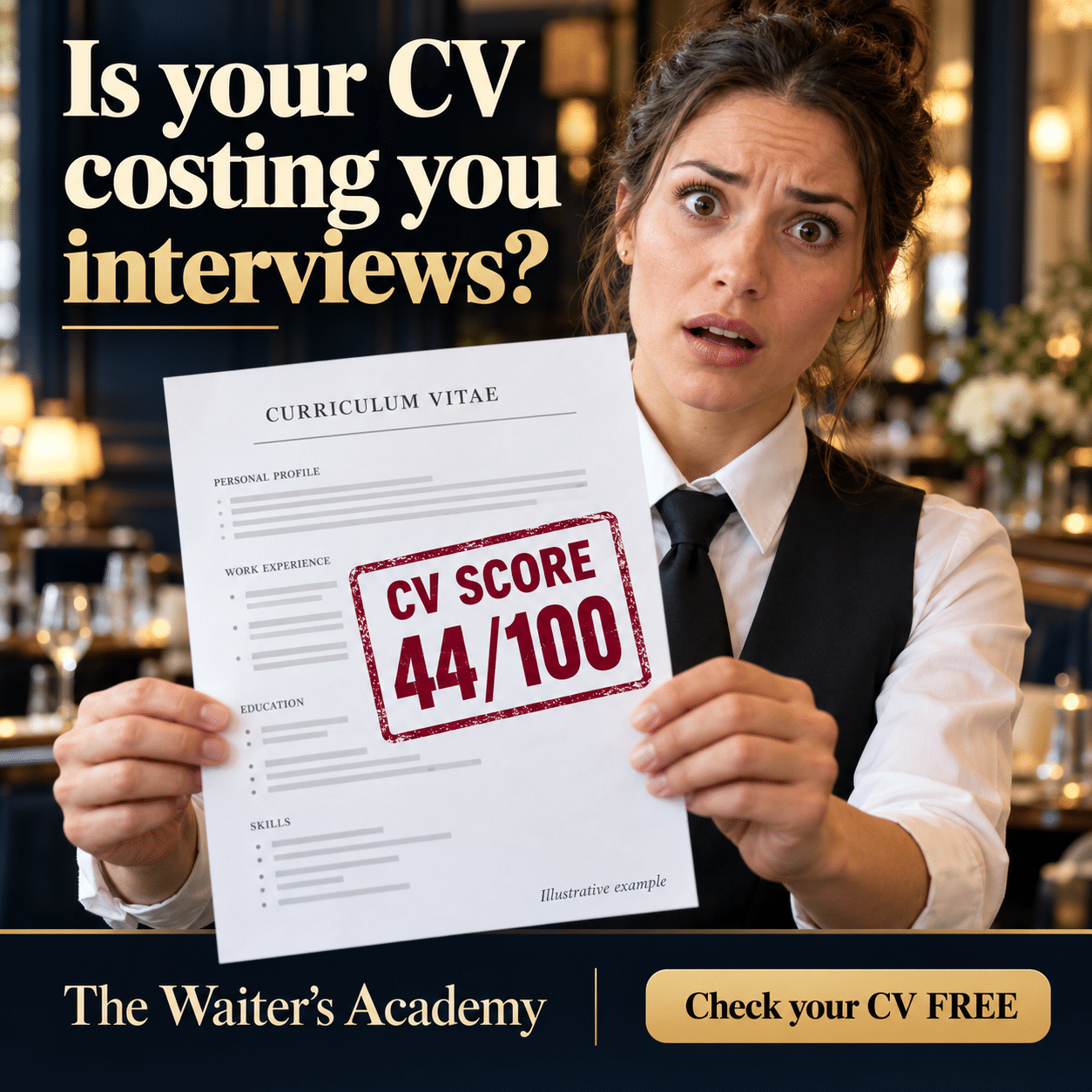
Is your CV costing you hospitality job interviews?
You may have the experience a restaurant or hotel needs. But does your CV make that experience clear?
A CV cannot guarantee an interview. It can, however, help an employer understand your relevant skills, responsibilities and achievements. The aim is to make those facts easy to find.
Here is how to improve your hospitality CV before your next application.
1. Make the role you want clear
Start with a short professional summary that connects your experience to your target position. Avoid a paragraph that could describe almost anyone.
Vague: “Hardworking professional seeking a challenging opportunity.”
More useful: “Waiter with restaurant and hotel experience in à la carte service, guest communication and POS order handling, seeking a front-of-house position.”
This is an illustrative example: use only the experience you actually have. Hosco recommends a brief summary and tailoring your professional history to the position.[1]
2. Tailor your CV to the vacancy
Read the job advertisement before editing your CV. Identify the requirements you can genuinely demonstrate, then make those details visible.
For a waiter vacancy, that might mean table service and order accuracy. A bartender application might emphasise cocktail preparation and stock handling. A supervisory application might need examples of staff training and shift coordination.
Marriott advises candidates to make sure their experience matches the role and that both their CV and application highlight the relevant qualifications.[2]
Keep your job titles and employment facts accurate. Tailoring means choosing relevant evidence, not changing your history.
3. Show what you did—not just where you worked
A hotel name and job title provide context. Add specific responsibilities to explain your contribution.
Vague: “Responsible for customer service.”
More useful: “Took food and beverage orders, entered them into the POS system and coordinated with the kitchen during dinner service.”
Other illustrative examples:
- Explained menu items and referred allergy questions through the restaurant’s established procedure.
- Prepared table settings and supported service for private events.
- Helped new colleagues learn opening and closing routines.
Use examples that reflect your actual work. Indeed Flex recommends backing hospitality skills with evidence rather than relying on terms such as “hardworking” or “team player.”[3]
4. Add achievements when you can support them
Include outcomes alongside your responsibilities: documented guest recognition, a promotion, training delivered or a service improvement you helped introduce.
Numbers can clarify the scale of your work, but they must be accurate.
Illustrative example: “Trained four new servers on POS order entry and closing procedures.”
If you cannot verify a sales increase, do not invent a percentage. A specific, truthful example is more useful than an impressive claim you cannot explain.
5. Make your employment timeline understandable
List your most recent role first. Give each position a job title, employer and consistent dates.
For example:
Waiter | Example Restaurant, Dubai | May 2023–August 2025
Label seasonal contracts, internships and overlapping part-time roles clearly. If you have an employment gap, a brief factual explanation can help clarify the timeline without disclosing private details.
The National Careers Service recommends reverse chronological work history, including employers, titles and dates, and recognises that gaps between jobs are normal.[4]
6. Include skills that matter to the job
Choose relevant skills you can discuss or demonstrate:
- Service: à la carte, banqueting or another service style you have used.
- Systems: the POS, reservation or hotel software you know.
- Languages: each language with an honest proficiency level.
- Training: relevant hospitality qualifications and completed certificates.
Avoid listing skills simply because they appear in the advertisement. Indeed Flex highlights role-specific technical skills, relevant qualifications and evidence of guest service, teamwork and communication.[3]
For certificates, include the course name and provider. Do not present training in progress as a completed qualification.
7. Keep the presentation easy to read
Aim for a concise CV—usually one or two pages for operational hospitality roles. Use clear headings, a readable font, consistent spacing and short bullet points.
Hosco recommends a professional, linear format and concise writing.[1] Follow the employer’s file-format instructions when submitting.
Proofread the final version and check your phone number and email address. The National Careers Service specifically recommends clear formatting, accurate contact details and a second person checking spelling and grammar.[4]
8. Starting out? Show transferable experience
You do not need to invent hospitality experience to apply for an entry-level role.
Retail work can demonstrate customer communication and payment handling. Volunteering or organising a student event can provide examples of teamwork and responsibility.
Marriott encourages candidates to highlight relevant experience beyond their exact job title and their willingness to learn.[2] Explain what you did and how it relates to the vacancy.
Check your CV before your next application
- Is my target role clear?
- Have I shown relevant responsibilities and achievements?
- Are my dates, qualifications and contact details accurate?
- Can I explain every claim in an interview?
Want feedback on your own CV?
The Waiter’s Academy’s free hospitality CV assessment tool reviews your CV and provides an assessment with recommendations for improvement.
Upload your CV, read the feedback and use it to strengthen your next application. The assessment is a guide to improving your CV, not a prediction of an employer’s hiring decision.
Try the free CV assessment at The Waiter’s Academy.
Related resources
- Hospitality Career Accelerator for structured career and application support.
- Professional Waiter Training Course for practical front-of-house training.
- More hospitality career and service articles from The Waiter’s Academy.
Research sources
- Hosco: CV Tips: 7 Ways to Catch a Recruiter’s Attention
- Marriott: An Inside Look at Our Job Application & Hiring Processes
- Indeed Flex: Hospitality CV: key skills to include
- National Careers Service: How to write a CV